


7 tattoo balm ingredients to avoid (and what to use instead)
Not all tattoo balms are created equal — and some can actively harm your tattoo
You wouldn't put random chemicals on an open wound. But that's exactly what's happening when you use the wrong tattoo aftercare product. The skincare industry is full of ingredients that look fine on the label but are actually problematic for fresh tattoos.
Here's what to avoid — and why — when choosing a tattoo balm or aftercare cream.
The 7 ingredients to avoid in tattoo aftercare
1. Petrolatum (Petroleum Jelly, Vaseline, Mineral Oil)
The classic offender. Petrolatum creates a thick occlusive barrier that traps everything underneath: lymph, sweat, bacteria, even ink particles still rising to the surface.
Why it's bad for tattoos:
- Blocks airflow → slows healing significantly
- Traps moisture and bacteria → infection risk
- Can pull fresh ink out of the skin in the first 24 hours
- Causes "ink rejection" patches in some cases
What to look for instead: plant-based oils and butters (shea, cocoa, jojoba).
2. Parabens (Methylparaben, Propylparaben, etc.)
Synthetic preservatives used to extend shelf life. The problem: they're known endocrine disruptors and frequent skin irritants.
Why it's bad for tattoos:
- Higher risk of allergic reactions on already-stressed skin
- Linked to hormonal disruption (controversial but worth avoiding)
- EU has restricted some parabens — a red flag
What to look for instead: natural preservatives like vitamin E, rosemary extract.
3. Synthetic Fragrances (Parfum, Fragrance)
One of the top causes of contact dermatitis in skincare. "Fragrance" on a label can hide dozens of undisclosed chemicals.
Why it's bad for tattoos:
- Triggers allergic reactions in sensitive skin
- Burns and stings on fresh tattoos
- No therapeutic benefit — it's purely cosmetic
What to look for instead: unscented products, or those scented only with essential oils in low concentrations.
4. Lanolin
A grease derived from sheep wool. Used in some traditional aftercare products (like Bepanthen).
Why it's problematic:
- One of the most common contact allergens in skincare
- Not vegan
- Can cause delayed reactions — you feel fine for days, then rash appears
What to look for instead: plant-based emollients (shea butter, mango butter).
5. Alcohol Denat (Denatured Alcohol)
Different from "fatty alcohols" like cetyl alcohol (which are fine). Denatured alcohol is the drying, stripping kind found in toners and sprays.
Why it's bad for tattoos:
- Strips natural oils from already-compromised skin
- Slows healing
- Can sting badly on fresh wounds
6. Essential Oils in High Concentrations
Surprising, right? Essential oils are "natural," but they're also potent allergens when used too concentrated.
Worst offenders for tattoos:
- Tea tree oil (>1% can irritate)
- Eucalyptus oil
- Citrus oils (cause photosensitivity)
- Cinnamon oil
What to look for: if essential oils are used, they should be low in the ingredient list (under 1% total).
7. PEGs (Polyethylene Glycols)
Synthetic emulsifiers used to mix oil and water in creams. The PEG itself can be fine, but during manufacturing they're often contaminated with 1,4-dioxane, a known carcinogen.
Why it's risky:
- Penetration enhancers — they help OTHER chemicals get into deeper skin layers
- Quality varies wildly between manufacturers
- No real benefit for tattoo healing
What to look for instead: the ideal ingredient list
A premium tattoo aftercare product should contain mostly these:
Carrier oils and butters
- ✅ Shea Butter — deep moisturizing, anti-inflammatory
- ✅ Cocoa Butter — rich in antioxidants, locks in moisture
- ✅ Jojoba Oil — closest to human sebum, non-comedogenic
- ✅ Coconut Oil — antimicrobial, moisturizing
- ✅ Argan Oil — rich in vitamin E
Healing actives
- ✅ Calendula Extract — anti-inflammatory, wound healing
- ✅ Aloe Vera — cooling, hydrating, healing
- ✅ Panthenol (Vitamin B5) — promotes skin regeneration
- ✅ Allantoin — soothing, accelerates healing
- ✅ Vitamin E (Tocopherol) — antioxidant, natural preservative
Structure ingredients (vegan)
- ✅ Candelilla Wax — vegan alternative to beeswax
- ✅ Carnauba Wax — plant-based thickener
How to read a label like a pro
Ingredients are listed by concentration. The first 5 are 80% of the product. If you see petrolatum, lanolin, or parabens in the first 5, put it back.
If "fragrance" or "parfum" appears anywhere, be cautious. If it's the second or third ingredient, avoid entirely.
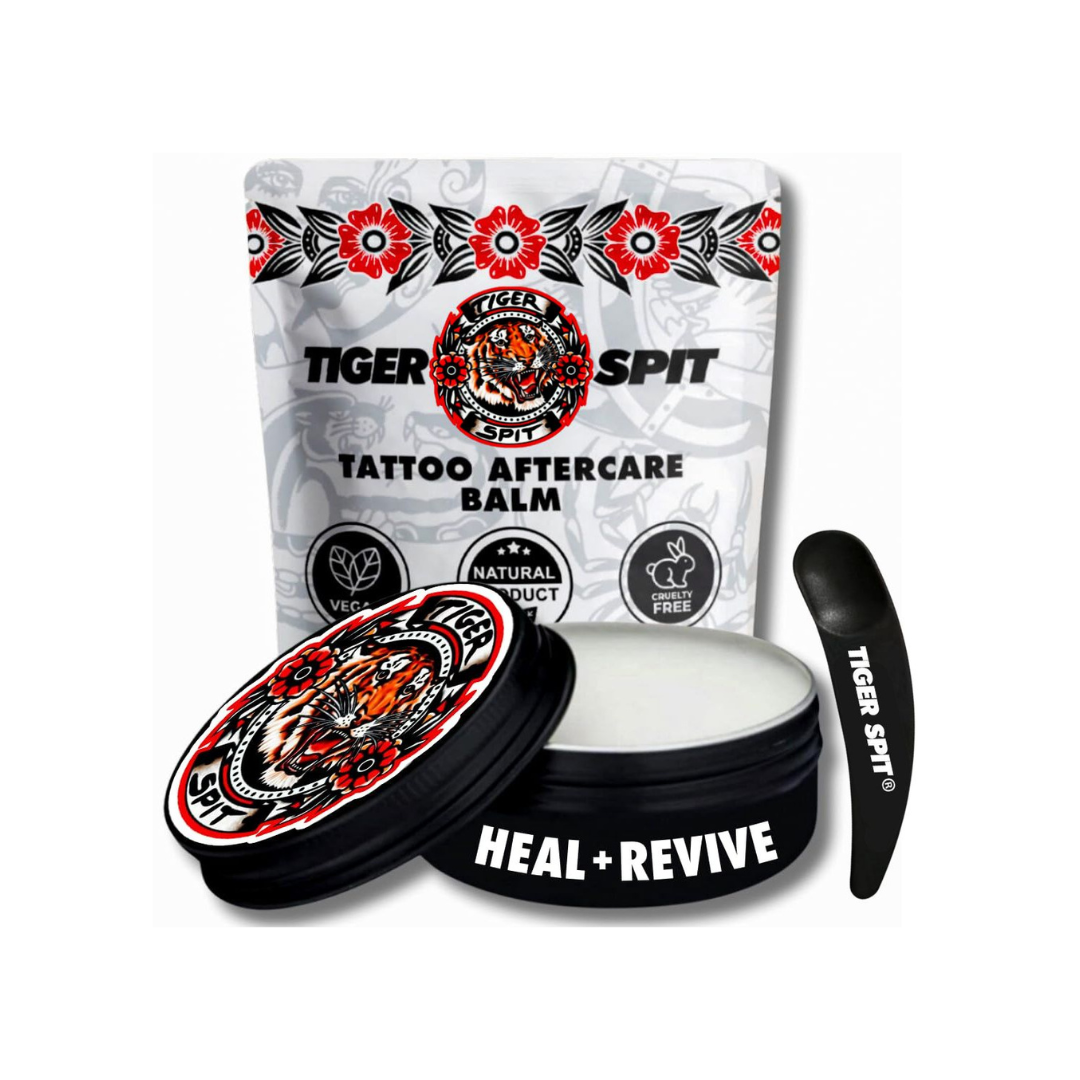
The TIGER SPIT approach
Our Tattoo Balm and Tattoo Cream are formulated with:
- ✅ 100% vegan ingredients
- ✅ Zero petrolatum, zero parabens
- ✅ No synthetic fragrances
- ✅ No lanolin (allergen-free)
- ✅ Active healing ingredients (calendula, panthenol, aloe vera)
- ✅ Made in Italy with EU-certified ingredients
Bottom line
Your tattoo is an investment of time, money, and pain. Don't compromise it with cheap, outdated aftercare products. Read the ingredients list. Avoid petrolatum, parabens, and synthetic fragrance. Choose clean, plant-based products.
Your skin (and your tattoo) will heal faster, stay brighter, and look better for decades.